A rattlesnake sat on my lap recently. Wrapped in a burlap bag and placed inside an open cardboard box, it rose and swayed as it sniffed the air to determine where it was. Another timber rattler lay beside me, snug and secure in a closed box on the truck's seat between me and the driver, MacKenzie Hall, timber rattlesnake researcher. The big Ford bumped its way over Ringwood State Park's dirt roads upward, toward the two snakes' lifelong homes high in mountain country, but not far from the crowds.
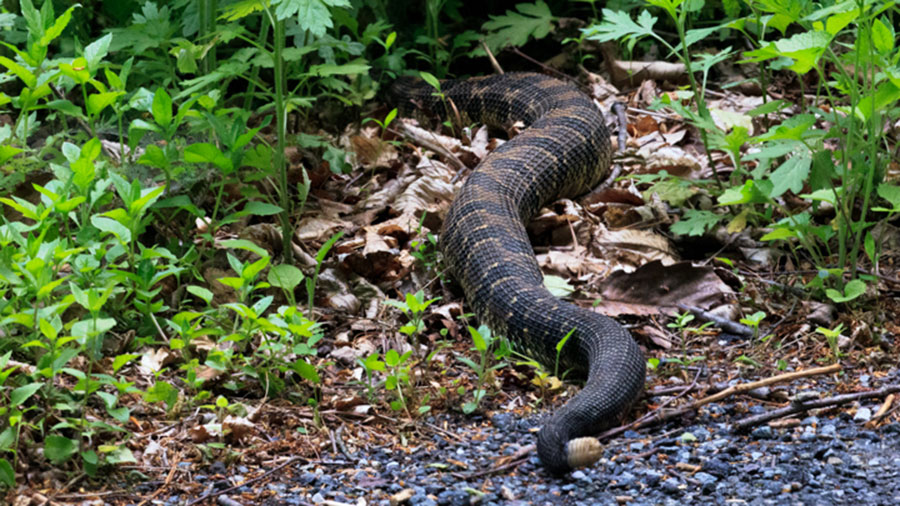
Hall pulled off the road. Carrying one bagged rattler she trudged uphill to return it to exactly where she had captured it a week ago. She untied the bag and it moved easily onto the ground. The snake, no longer feeling threatened, quit rattling at us. He flicked his tongue to pick up chemical scents to reorient himself to this former hunting spot. So far this year, Hall's data shows that this mature snake has moved three-quarters of a mile, perhaps looking for a female. We left him to get back to snake business.
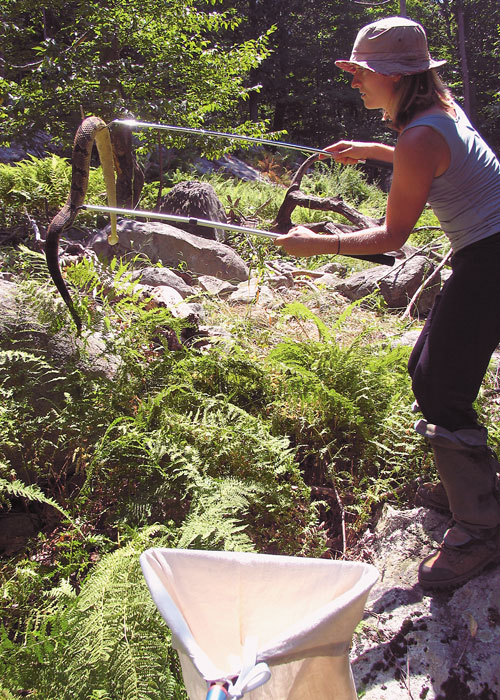
Hall, a seasonal intern (in 2005) with the NJDEP, Division of Fish and Wildlife, Endangered and Nongame Species Program (ENSP), conducted field research for the Timber Rattlesnake Highlands Project. The Highlands are one of the few last strongholds for New Jersey's endangered timber rattlers, but human settlement has made their existence more visible. All of the snakes in the study are males that were found on private properties, whose owners contacted ENSP. The venomous snake response team rescued the snakes. It was not that the snakes got lost, or that they enjoy human construction. They were simply doing their snake activities on what was once their own foraging turf. As calls flooded in it became clear that in order to save the rattlers, biologists needed to know more about their denning, hunting and breeding habitats.
As new development goes up the mountainsides, the snakes get pushed out of their home range. In one recent project that abuts parkland, a few houses were built on a favored basking area located between two dens. The two snake populations had used this rock outcrop to warm up and help shed their skins. It was an important area for breeding and maintaining genetic diversity. It's now gone.
During the breeding season, July through August, they stay in the woods to look for females. "But last year there was movement early on," says Kris Schantz, ENSP senior biologist who heads the timber rattlesnake research. "A new section was developed over winter. It may have been a basking area. It's confusing and now they're wandering around looking for a place to bask and forage. They're perhaps just as confused as the land owner, when they show up on what was once their foraging ground and now it's a house."
In order to track the snakes and learn their lifestyles, biologists tuck a transmitter under a rescued rattlesnake's skin, then release him in a wild place within a couple hundreds meters from where he was found. This is part of their home range. "That is because timber rattlesnakes and copperheads den for life in one place. If they are moved away from their den, they'll spend all their energy finding it or die trying. They know where their home is, their food and their mates and, most importantly, their den," said Hall. The transmitters last for a year, then researchers recapture the snakes and remove the transmitters. From spring through fall, Hall tracks the snakes every other day with a radio telemetry unit that picks up the unique signal assigned to each snake.
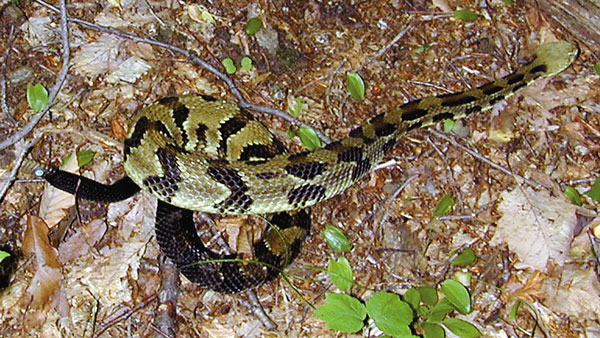
Rumbling down the road, the truck came to a stop. Hall hopped out and brought the second male to a shrubby area where he had been captured. She had found him coiled on a big limb facing another limb, waiting for an oncoming chipmunk or mouse, or maybe a bird. This immature male was mostly-yellow with dark chevrons, one of three color phases. He took his time slithering through the brush, heading back to the same pile of jumbled branches.
"These little guys are free now. They'll never see me again," said Hall. The two snakes had their transmitters removed the day before, but they still wear the blue rattle tag that marks them as captured and observed by the ENSP.
Driving slowly through Ringwood, she held the radio antenna out the truck window to find snake number three, one of the biggest male rattlers she has ever seen. She planned on bringing him in to have his transmitter removed.
Fine tuning her receiver, Hall tromped over fences and through thickets and found the snake in a tangle of grape vines and brush surrounded by wildflowers just where she thought she would. She had been following him for a year now, and knew his den was two miles away. Some larger males move two to three miles from their den, and over a mile a day looking for females.
As she honed in on the male's radio frequency, she had her hooks at the ready. At the ends of long poles, the hooks would hold him gently while lowering him into the bag, but the male and his mate slipped through the protective mass, making capture impossible. She took data: temperature, behavior, and response to her presence, then decided to come back later, hoping he would change location.
She records their whereabouts, what kinds of plants they hide out in, topography, distance to closest rock and log, overhead tree species, slope of ground, and lots of other facts about these timid snakes "to get a handle on different habitat preferences," she says. "One idea of the project is that you can't adequately protect any animal without knowing any of its habits and habitats. We want to know how far they're going, if they're eating or breeding, where they're sunning so we can encourage protection in the right places."
Eventually, ENSP will develop a landscape model statewide map that depicts critical species' habitats as a tool for developers, planning boards, and other land users to know where sensitive areas exist, says Kris Schantz. "There is now no upland habitat protection in New Jersey. We hope that developers will be willing to work with us to minimize human rattler interaction."
The DEP will also use results of the study to educate people living in rattler territory about venomous snakes. So far, data shows that rattlers prefer talus slopes and outcrops for dens, and hardwood forests for foraging where they smell for rodent corridors.
Hall struck out across one of the Ramapo Mountains, trundling across roots and rocks, whipping through spider webs, and bushwacking through stickers to pop in on snake number four, a male shedding on a hillside. She collected data and went on her way to capture male number five to have his transmitter removed. He lay under a large rock with a female, slipping effortlessly out of reach when Hall probed gently with her hooks. She wanted to catch the female, too, to keep the breeding pair together, but the female hid between the rock and wiry fern stems. At last Hall caught the male and placed him inside the canvas snake bag that this writer boldly held, hoping the rattler would be a good boy. A rattlesnake can strike up to half their body length, she knew. The female snake would probably still be waiting when her mate returned a few days later.
We headed back for one more try at the male in the grape. He was still in the vines, unattached to the female and still impossible to catch.
Timber rattlesnakes are state endangered and protected by law. They are vulnerable animals. As part of a forest's ecology, they keep the rodent population down and in turn are eaten by hawks, owls, other snakes, and coyotes. They disappear in the hands of collectors, the jaws of predators, and the shovels of bulldozers. They die crossing roads. They die because their den becomes the home of homo sapiens.
They reproduce slowly, becoming sexually mature at eight to nine years old. Females give birth only every three to five years. They breed in the summer and over-winter the sperm, until early spring when the eggs are fertilized. They give birth to live young in late September, then recuperate for a few years.
Hall says that most people have the wrong idea about New Jersey's venomous timber rattlesnake and Northern copperhead. "Timber rattlesnakes are such docile animals. All they want to do is stay out of the way. They need their venom to subdue prey, so they're not going to waste it on just anything that comes their way."
These heavy-bodied "ambush predators" eat rodents and birds. They don't rely on speed, just their sense of smell. They often curl up behind a rock or a log where rodents have been, and wait, head up, coiled, ready to strike. Be careful where you step! One summer, Hall found one rattler almost four feet up a sugar maple with his head cocked back facing the crotch of a double-trunked oak and waiting, perhaps, for a bird.
From late September to early October, the snakes start making their way back to their dens below frost line so their bodies don't freeze. Dens face the southern sun so the snakes can come out and get warm during fall before the weather freezes and in spring after the ground thaws.
By now, Hall thinks the snakes sort of know her. She hardly ever gets rattled at for she approaches them slowly. They rattle, after all, only when they feel threatened, but not to warn. "They would rather attempt to remain invisible than make their presence known."
Please note that although the information presented here is relevant, the ENSP study referred to in this article ended years ago. You should REPORT ANY SIGHTINGS of timber rattlesnakes—or any other of New Jersey's rare species—using the Rare Wildlife Sighting Report Form found here. The current list of NJ's rare, threatened, and endangered species is also posted on this page at the Conserve Wildlife Foundation of New Jersey.
The rattlesnake's rattle is made from modified scales from the tip of the tail which resemble hollow beads. Each time the snake sheds its skin, a new rattle segment is added. Newborn rattlesnakes do not have functional rattle -- they have only one segment with nothing for it to rattle against.
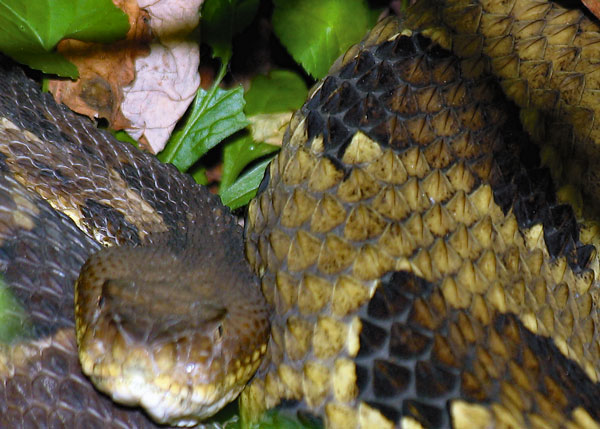
Rattlesnakes are pit vipers, which means they have highly specialized heat receptors between the eyes and nostrils that help them find prey. The snake can judge both the distance and relative size of its intended victim and aim the strike at the warmest part of the target. Rattlesnakes are born live and with fully functional fangs in the upper part of the mouth that fold in when not in use. When the snake attacks, it unfolds its fangs to inject venom. The venom, held in sacs on either side of the back of the jaws, gives the pit viper's head a triangular shape.
Timber rattlesnake venom is essentially digestive, destroying tissue and causing severe pain. If promptly and properly treated a rattlesnake bite is not generally fatal for adult humans, although some degree of permanent scarring is likely. Delayed or ineffective treatment can lead to loss of a limb.
Although these snakes are relatively docile by nature, they are extremely dangerous when frightened or challenged. Rattlesnakes control the amount of venom they inject, usually delivering a full dose to prey, but smaller amounts, sometimes none, when biting defensively. A significant exception is a badly frightened or wounded snake, or a very young snake which has not yet learned to gauge the venom delivered. In any case, if you are bitten, always assume that venom has been injected and seek immediate help.
The amount of venom injected from a snake bite, called envenomation, cannot be easily gauged. Symptoms and swelling may occur quickly, but in some cases hours may pass before the worst effects appear. Emergency medical technicians gauge envenomation in stages equated to the amount of bruising and swelling around the fang marks, and how fast the bruising and swelling progress. In severe cases there may be symptoms like lip-tingling, dizziness, bleeding, vomiting, or shock. Quick medical attention is critical, and typical treatment requires antivenin to block the tissue destruction, nerve effects, and blood clotting disorders associated with rattlesnake venom. Most medical experts recommend keeping the bitten body area below the heart level, and keeping the victim calm while transporting. It is not recommended for untrained people to make incisions at or around bite, or to use tourniquets, since the damage from this "treatment" can be worse from that resulting from the bite.
Please REPORT ANY SIGHTINGS of timber rattlesnakes—or any other of New Jersey's rare species—using the Rare Wildlife Sighting Report Form found here. The current list of NJ's rare, threatened, and endangered species is also posted on this page at the Conserve Wildlife Foundation of New Jersey.