Wildlife Rescue

Animal Tears

By Royal J. Nadeau PhD

Last spring, our neighbor called to us from her deck. "There is a baby deer in the bushes. It's been bleating for two days and driving my dog bonkers. We haven't seen the mother around either." Then we remembered seeing a dead deer on the side of the road not far from our house and made the connection.
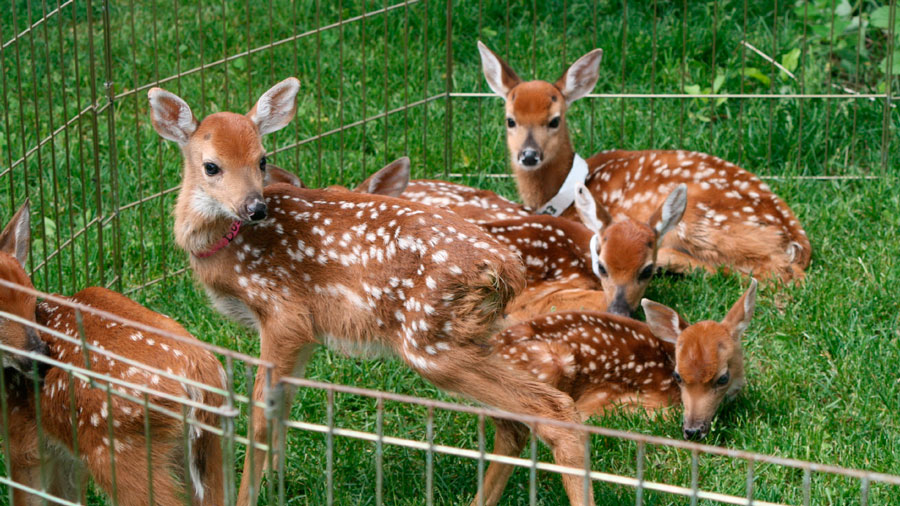
Our neighbor had called Animal Control who informed her that Antler Ridge Wildlife Sanctuary was the closest place to take an orphaned fawn. We gathered up Bambi with some towels and a blanket and headed over to Frelinghuysen in Warren County. Kelly Simonetti, a licensed Wildlife Rehabilator with the NJDEP, and owner of Antler Ridge, showed us the cage where we stowed the helpless infant.

fawns
Fawns at Antler Ridge Wildlife Sanctuary

That was our first meeting with Kelly. Little did we know that my wife and I would spend every Sunday afternoon for the rest of the summer feeding the orphaned fawns (all twenty-seven of them), and helping with many of the other animals acquired during three years of operation at Antler Ridge, a 120-acre preserved farm. The state-licensed sanctuary provides emergency care for fawns, raccoon, skunks, opossums, squirrels, rabbits, woodchucks and other small mammals that are sick, injured or orphaned.

Wildlife rehabilitators follow a prescribed regime for introducing rehabbed critters back into their natural environs. As Kelly puts it, she does not want these animals to "ever like these digs so much that they do not want to leave." Patients remain in captivity only until they are able to live independently in the wild. Because fear of humans is a necessary survival trait for wild animals, an elaborate time-consuming process is often required to insure that every effort is made to minimize human contact and avoid taming.

The NJ Division of Fish & Wildlife has strict guidance on how and where rehabilitated animals are put back into their natural habitat. Ideally, all terrestrial animals should be released as close to the initial site of capture as possible. Normal home ranges and dispersal distances for a species should be considered to prevent unnatural spread of disease and unnatural gene flow. Release of wildlife in a location other than the site of capture exacerbates competition for limited resources at a given location and should therefore, be avoided whenever possible.

In the case of rabies vector species (raccoons, skunks, etc.), the animals must be taken back to the county where they came from in order to diminish the potential for spreading the disease. Although all wildlife rehabilitators are trained to readily recognize the symptoms of rabies, a positive diagnosis cannot be made unless the animal is euthanized and brain tissue sent out for analysis.
hawk rehab
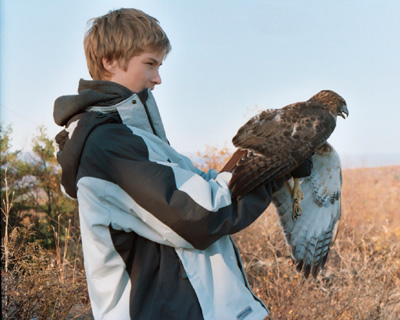
Justin Smisko about to release a rehabilitated red-tailed hawk at Avian Wildlife Center

In some cases, an injury may be so persistent that it will always threaten an animal's ability to survive in the wild. Some wildlife rehabilitation centers make use of these debilitated animals in education outreach programs. Giselle Chazotte Smisko founded and runs the Avian Wildlife Center in Wantage with her husband, John, and their two sons. They take in all wild bird species but specialize in raptors and songbirds. The birds that cannot be released back into the wild become subjects for presentations to school groups and local organizations. Giselle shares with other wildlife rehabilitators the idea that making the public aware of the stress and perils that New Jersey's wildlife must endure is a vital component of their mission. The fragmentation of range and habitat forces these animals to closer human contact that would otherwise not happen. The common goal of wildlife rehabilitators is to work in concert with the public and to promote a responsible concern for living beings and the welfare of the environment.

Wildlife rehabilitators in New Jersey need to be licensed with the Department of Fish and Game under the Non-Game and Endangered Species program. Besides submission of reports and various permits, a minimum of one-year apprenticeship is required prior to being issued a license. Working with federally protected species migratory birds and federally listed endangered species requires permits issued by the US Fish & Wildlife Service.

Although a college degree is not required to become a licensed wildlife rehabilitator, a background in biology or a related field provides obvious advantages in understanding the needs of distressed wildlife, as well as their relationship to humans and the environment. Kelly Simonetti, Hope Kosch-Davison (Wild Baby Rescue) and Donna Fox (Rocky Springs Wildlife Rehabilitation Center) are registered nurses. Giselle Smisko is a veterinary technician, has a BS in Biology and served as a volunteer intern at The Raptor Trust in Basking Ridge with that organization's founder, Dr. Leonard J. Soucy. Harriet Forrester (Turtle Rescue of New Jersey) is a trained veterinary technician. But as Linda Mihatov (Wildlife Rescue) points out, "There is no classroom learning that can substitute for the hands-on experience from serving as an intern working along side a wildlife rehabber."
woodchuck
Yebba, the woodchuck. Photo Courtesy of Wild Baby Rescue in Blairstown, NJ

A number of colleges and universities have recently included courses on wildlife animal care within their veterinary and wildlife management curriculums. At Wild Baby Rescue Center in Blairstown, Hope Kosch-Davison receives help during the summer from pre-vet college student volunteers who are interested in learning more about the animal husbandry requirements of wild species and what it takes to be a wildlife rehabber.
fox kit
Fox kit at Rocky Springs Wildlife Rehabilitation Center.

Family members all contribute their time and talents towards the effort whether it involves building cages and enclosures, feeding and caring for the animals or helping with the business end of running a wildlife rehab. And none of the rehabbers could function effectively without a corps of volunteers who show up on a scheduled basis to assist with the feeding and caring of the animals. In March and April, the rehabbers conduct training sessions for people who want to participate, and special training sessions are held throughout the busy season on a case-by-case basis. For special projects, like building or assembling cages, a team of willing folks may show up as part of their employer's community service outreach. This spring, a team from Home Depot in Newton will assemble a donated large enclosure for foxes or coyotes and a fawn pen at the Wild Baby Rescue Center in Blairstown. The Girl Scouts will provide refreshments for the volunteer workers.

None of the wildlife rehabilitation centers mentioned here receive public funds, and therefore rely heavily on monetary donations. You can donate directly from some of their Web sites. Other rehabbers tap into Internet Web sites that will contribute a portion of their advertising revenues. For example, you can help Rocky Springs Wildlife Rehabilitation Center by using MissionFish , a site that allows eBay users to donate some of their earnings to the center.
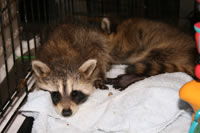
raccoon
Baby raccoon.

If you find an injured or orphaned bird or animal, call a licensed professional wildlife rehabilitator, who will be able to recognize if the animal is in distress or not. Do not feed a wild animal. Providing the wrong type of food or drink could cause serious harm.

If it is necessary to move an injured or abandoned animal, wear gloves. Put a baby in a secure box or pet carrier. Provide a heat source for warm-blooded animals (a soda bottle filled with hot water put in a sock, or a sock filled with rice and heated till warm in the microwave are good sources of heat). Keep rescued animals in a dark and quiet place away from pets and children.

Wildlife Rescue Resources

Antler Ridge Wildlife Sanctuary
Deer, raccoons, skunks, woodchucks, squirrels. Frelinghuysen, 973-800-2420
Avian Wildlife Center
All bird species including waterfowl, raptors. Wantage, 973-702-1957
Rocky Springs Wildlife
Rehabilitation Center Small mammals, songbirds, waterfowl and raptors, snakes, coyotes, bats, turtles. Broadway, 908-835-9991
Turtle Rescue of New Jersey
Hardwick, 908-362-7747
Wild Baby Rescue
Small mammals, bats, coyotes, woodchucks. Blairstown, 908-362-9453
Wildlife Rescue
Rabbits, squirrels, small mammals. 973-948-0037
New Jersey Fish & Wildlife
National Wildlife Rehabilitators Association

Comments

DS
24 Jul 2010, 09:35
Cathy. Look at the post from Emma. It is under urs. Call the Absecon Vet that she recommends. The toe by be necrotic (dead). Don't know why that would happen in a bird toe though. It may need to be amputated which would be kinda brutal :(. Keep us posted but call that number.
Cathy
24 Jul 2010, 09:20
can anyone help us?? i have found a young baby bird that looks like it can be a ring neck dove. It isn't that young that it can't eat by itself but its really small and can't fly yet. She has all her features. She can't stand or walk. One of her toes looks slightly darker than the others. She refuses to use her right foot at all. You can really see the pain she's in as she opens her mouth and closes it non stop as if she almost drowned or out of breath. she got to the point where she even allows humans to touch her without complains. normally she warns people by opening her wing. There aren't any bird vets in our area :( anything we can do at home for it? Or is ending her pain the right way (i really rather not kill her) ?
Emma Yulick
20 Jul 2010, 12:47
Lisa! call absecon veterinary hospital 609-646-7013. they have a wonderful person there who takes in baby birds and rehabs them; I don't remember her name (Liz?), but the receptionist will help you. I brought my baby starling rescue to her and they took the little guy cheerfully. I had been refused any help at all from local animal shelters and several south jersey "bird rescue" places.
lisa
19 Jul 2010, 19:04
hi.. i have a baby bird that fell out of his nest.. i left it outside for a while today and the mother fed it.. but i couldnt leave it out overnight.. i dont know what to do with him.. he cant fly yet.. i have three dogs.. so i cant just leave him outside during the day and hope he learns to fly soon.. any suggestions would be very helpful.. hes alert and opens his mouth for food.. adorable little guy/girl.. i live near toms river.. help please..!!
Ester Shields
17 Jul 2010, 09:36
My brother just called me and said there is a mother deer with a compound leg fracture and she is nursing two fawns. He doesn't know what to do about it, if anything can be done at all. The fawns still have their spots but are about the size of Labs. What should he do?
Jo Ann
16 Jul 2010, 07:07
There is a coyote loose in our residential neighborhood in Towaco, New Jersey. It looks unhealthy only because it's thin and has no fur on it's tail. It's been out during the day.I will try to find a santuary to rescue it in New Jersey. I don't believe in having any of the critters killed. Hopefully, someone will help it regain it's strenght and find a new home for it.
Cindy
07 Jul 2010, 14:11
There is a baby bird at 94 Marion pepe dr in lodi in a blue plastic container...it needs help...fell out of a tree and no one knows what to do...plz send help asap...the heat will kill it!!!
Cindy
02 Jul 2010, 13:39
Help!

There is a loose deer in our town (Rutherford, NJ). I know that if it's not rescued it will get hit by a car sooner or later. What can be done? The police or animal control would not do anything. Please help me!
Cindy
Christina
21 Jun 2010, 07:50
I live across the street and turtles and geese are always getting hurt I save them as much as I can but it is a busy street and they do get hurt. I wish there was a way we could at least get slow signs or a speed bump out there for them as it kills me to see them getting hurt all the time. If someone could help me I would really appreciate it. Thanking you in advance.
Emma Yulick
20 Jun 2010, 18:28
Hi,
My daughter and I rescued a baby starling today. He (assuming gender) was running across the road on the garden state parkway rest stop; I had to swerve to avoid him, as did the car behind me. I could not locate a nest; he for sure fell from it as he cannot fly. the little guy has some down, some skin area where feathers are developing, and some pin feathers. He's now been hydrated and is resting in a warm box. I've mixed some food for him according to a website I found dealing with wild baby starlings but he hasn't woken up yet from his nap. I think his day was really traumatic and by the time evening fell (we found him around 6pm), he just settled in for a nice sleep.
However, as prepared as I am to feed the little fellow when he wakes up, I would prefer someone who has experience with this. We called our local animal rescue who said call the police, they'll call some other rescue. we called the police who said to call a bird sanctuary or something, who said to call yet another person, who said they couldn't help.
Anybody got any info?
Donna Schultz
12 Jun 2010, 16:12
Hi, there is a very small fawn that has been sitting next to our garage door all day today. It is right next to our house despite there being many trees and bushes in the yard it should be hiding in. Have not seen the mother and don't know what to do. Need to get my car out tomorrow and don't want to scare it away for fear of the mother not being able to find it. What should I do? It looks hungry and thin but healthy. It is mouthing small plants but not eating them.
Brian
09 Jun 2010, 08:41
I have three red eared terepin turtles that are in desperate need of a home.I live in essex county and will deliver.If anyone can help,please respond.Thank you.
Johanna Rojas
05 Jun 2010, 15:33
Hi,


My husband rescued a turtle that he was going to run over with his truck, it is a red-eared slider. We have temporarily have kept it until we know who to contact to bring it safely to the wildlife. Please we are in Wayne NJ. If anyone can guide as what to do we have never had a turtle before and I it doesn't want to eat.
Saravana Moorthie
10 May 2010, 14:48
My name is Saravana Moorthie. I stay in Jersey City,NJ and I have 2 beautiful Southern Painted Turtles. They are a pair, probabaly less than 1 year old and very healthy. They even come and grab food from my hand. I bought them 2 months ago but unfortunately I am in a position to give them away.
I do not wish to sell the turtles, but hope to find them a wonderful home. I would want to give them to someone who loves reptiles and would care for them. I was wondering if there a repltile lover who would be willing to adopt these turtles. I am also giving away a repto filter, a 9 - 10 inch decorative tree that fits in a 40 + gallon tank, a docking pad and their food.
Kindly let me know if you would be comfortable to share your home with my Turtles. My number is 551 689 6149
michelle jacob
08 May 2010, 19:58
I had found a newborn bird in my yard today. I'm guessing because of the wind, it must have been blown out of a nest somewhere in the tree but i cannot see a nest. the bird was in the same place for over three hours so i had brought it inside to protect it from cold and preditors. what do i do now? it barly moves and hasn't opened eyes or mouth to eat. who do i call to rehabilitate the bird?
Rosemary Stacy
14 Apr 2010, 19:19
Dear Sir:
There are 2 beautiful Mallard ducks that have set up their nesting in front of the A&P Supermarket in Woodland Park, NJ. How do I find someone to rescue them?

Sincerely,
Rosemary Stacy
973-632-9698
Mike
14 Apr 2010, 11:57
Hi,

I have a den of Kit foxes that is located in my back yard in Wantage New Jersey. The other night I heard what sounded like screaming coming from the back yard. Since then I have not seen the mother fox and the kits ( 3 of them ) are just sitting outside the den.It been about three days now and Im concerned the kits are going to starve. Is it possible to have them rescued ? They are not that old but big enough to play out side of the den.
Jennie
03 Apr 2010, 14:22
there is a full grown male robin sitting on my lawn (manasquan, monmouth county) and hasn't moved in over an hour - even when i get close to him. i tried calling a sanctuary, but they are closed (after 5 on Saturday). I don't know what to do, but I am afraid for the bird as there are 2 stray cats in the neighborhood...
Kristin
08 Nov 2009, 06:28
Hi Kelly, thank you for the information about does surviving on 3 legs. I came across a doe and fawn last night and the doe had an injured front leg.

You've put mind sort at ease

Kristin
Mike
07 Sep 2009, 12:07
baby squirrel just fell out of tree has head injury. wont get up but is moving and breathing. who should i call and what should i do!!!!! plz help cuz this is RIGHT NOW
kelly
31 Jul 2009, 05:17
STOP FEEDING THE FAWN, they do not eat bannas and bread..that is the cause of the dirrhea and dirrhea in fwans is fatal! fawns are between 3-4 months old and they are weaned, the fawn will travel with that group and should do fine but you have to stop feeding it or it will die from the dirrhea. they have to eat their native foods in the forest..they should not eat bird seed and corn its too rich for their developing systems..if you need further advise call antler ridge at 973-800-2420
Maryann
30 Jul 2009, 16:59
There is an orphaned fawn in the neighborhood. Mother was killed. It is about 8 or 9 weeks old. It follows another mother deer (w/2 babies of her own) around and tries to nurse. Of course, the mom kicks it away. The two other fawns don't seem to mind it following them around. The fawn can eat on it's own. Squirrel corn, bird seed, apples. The neighbor has been feeding it bread and bananas.I just noticed it has diarrhea. The fawn seems healthy (other than the diarrhea) and seems alert and is not injured. I see it eat plenty of my shrubs/flowers, etc. Any advise?
kelly
09 Jul 2009, 05:13
Melissa,
Belivelle has many areas for the deer she/he obviously has been born in the area and is supported by the river and vegitation. It is unfortunate thats not the best place for it but it does live there. We do not have a servce in NJ to relocate grown deer from populated areas, sorry. she has made it living in the "city" this long she is savy enough to be able to navagate the roads. Kelly Simonetti, Antler Rdige wildlife
Melissa
09 Jul 2009, 05:05
Hi I live in Belleville New Jersey which is 6 miles from NYC and there is a female deer in the river across the sreet from my house.Me and my neighbors have called animal control,aspca & the local police department but noone can help.The deer seems to have made a comfortable spot to lay down and I've seen it eat some foliage around the river but I'm concerned it will be hit by a car.I live on a very busy street that comes off the highway and someone said they seen it in the park eating at night.Who would help recue this animal to put in a safer enviroment? thank-you
Heather
08 Jun 2009, 03:56
Thank you so much Giselle for the quick response and sound advice. I will attempt to put them in the new nest today. I will keep you updated on what happens. I pray it works! Thanks again.
Giselle
07 Jun 2009, 15:29
Hi Heather:

We spoke on the phone about trying the nestlings in the other box with the predator guard that the parents have moved to after the attack. The fact that they were cold and quiet may explain why the parents did not return to care for them. Now that they are livelier and calling, the parents should respond. It is always best to try to get the babies back with the parents before taking them to a rehabilitator.
Heather
07 Jun 2009, 12:41
Hi,We are in a bit a a sad situation. I went out yesterday morning to find our Bluebird nestbox disturbed and 4 out of the 6 nestlings gone. We found scratch marks up the post, so we assume it was a cat or raccoon. We watched for the Mother to return into the box. Instead she and the male went to an empty nestbox and started to rebuild. Knowing the 2 nestlings who were about 2 days old, were going to die, I brought them in. The are being kept warm on a heating pad and we have been feeding them mealworms. They are now gaping, which they were not yesterday. I am looking for someone who rehabs songbirds. I would try to do it myself, however I feel a professional should instead. We are also leaving within 2 weeks for vacation. I am in Flemington, New Jersey in Hunterdon Co. If anyone knows someone please contact me. Thanks in advance.
Giselle
01 Jun 2009, 08:20
Karen:

Have you phoned a wildlife rehabilitator about the fawn? You can contact Antler Ridge or one of the other ones listed for deer on the state's website.
It is always wise to be cautious about handling an animal and risking exposure to rabies. However, It sounds as though the fox may have been just acting as a normal predator would.


Karen
31 May 2009, 22:42
I was awakened tonight by a screeching and bleating. When I ran outside I saw a fox was trying to drag a fawn up the driveway. The fox ran and I took the fawn into the garage. She was bleeding by the neck and ear. I stopped the bleeding and she is now resting comfortably. I did not see a mother near by although there was an adult doe in the area earlier. I am assuming the fox is rabid and if it bit the deer the fawn has been exposed. I am afraid if I let her back out she will be attacked again. She seems very young and a little unsure on her legs. Can you help me?
Giselle
22 Apr 2009, 10:02
For anyone experiencing a bird repeatedly tapping on your window:

It is the start of nesting season for many of the birds that nest in people's yards. Cardinals, robins, and other species that see their reflection in your window mistake it for an intruder and are trying to chase away their own reflection. They are not trying to get into your home. Some things to try to prevent this include turning on a light next to the window or putting something that moves outside the window (a banner or ribbons).

If you have questions about wild birds you are welcome to contact us.

Avian Wildlife Center, a N.J. Nonprofit Corporation
(973)702-1957
avianwildlife@embarqmail.com
Kelly
16 Apr 2009, 05:41
Maryann,
yes your other animals can get mange, the best thing to do is to trap the fox in a hava-a-hart trap and bring it to a local rehaber. they will be able to evulate and treat the amimal and relocate it out of a residental area. Kelly@Antler Ridge Wildlfie
Kelly
16 Apr 2009, 05:33
Cheri
she might be setting up a nest. Do the turkeys come through your yard? she might feel your yard is safe. they usually lay their eggs in mulch piles. if there was not ample food in your yard she would move on..best not to feed her becaseu she will not leave and will bring in the rest of the flock to your yard and they can be very terratorial. you can call antler ridge direct if you need additional informaiton. Kelly
Maryann
15 Apr 2009, 17:22
I recently have a red fox hanging around my house. It appears to have mange. I believe it sleeps in a dog house on my front porch (for my cats during the summer time). A) Can my cats catch this mange and B) who in Morris County will actually take the time and caring to try to catch the fox and treat it? I can only assume where there is one fox there are others and gee I would really hate to see more foxes develop the same (especially with baby season approaching). If I call animal control - they will simply kill it (they kill everything). I realize that this fox could be very sick especially if the mange is so bad that it affects it's immune system and then internal organs. Looking for some sound advise. Thank you, Maryann
cheri
15 Apr 2009, 15:45
I'm new to this page..but I have a wild hen turkey in my yard..she has been here for over a week and I'm worried that she won't be able to get back to her flock...I live in a small town but the outskirts are where I think she came from...She doesn't belong here but the animal control, aspca, and any other animal group can't help me...She is about 20 pounds and has decided to roost on my garage, and spends most of her time in my yard...about an acre...I don't think she is getting the best diet here and am wondering if I should get her some turkey scratch...I don't know what to do with her...I don't mind her here...but I can see that she wants to be in the wild...
any suggestions?
kelly
14 Apr 2009, 05:09
Antler Ridge Wildlife Sanctuary would like to remind residents that we are about to enter the season when our abundant wildlife will be having their young. A reminder all wildlife in NJ is protected by law and it is illegal to keep and raise wildlife.

Please do not disturb, handle or try to feed young wildlife, Wild mothers do not stay with their young, but hide some distance away. This instinctive survival behavior is necessary so that no attention is drawn to the helpless young in their nests. No human can offer better care to young wildlife than their natural mothers.

Please allow them to do so, if you have any questions or concerns please call Antler Ridge Wildlife Sanctuary or visit them on the web for specific information regarding baby wildlife.

Thank you
Kelly Simonetti, Director
www.antler-ridge.com
973-800-2420
Saving Lives, Preserving Wildlife, Enriching the Environment
kelly
14 Apr 2009, 05:01
Ben,
It is very difficult to rehabilitate a grown deer, they do not do well with anesthesia and usually die from the stress of human intervention. they can survive with three legs and since we have had a mild winter there is plenty food for them. the best thing to do is to let it be and it will compensate for the for the injuried leg. Kelly
Ben
03 Apr 2009, 14:17
An injured deer is in our back yard in scotch plains, nj. I believe it has a sprained or broken leg. The local authorities won't do anything. They will only kill it. Please help!
Chris
03 Apr 2009, 06:41
Ooops! My email is stanhopemom@aol.com or cferraro@stanhopeschools.org.
Chris
03 Apr 2009, 06:39
I am hoping someone can outreach and help a deer in trouble in our town. For the past few days, a deer has been located between our elementary and high school. It has a bowl stuck on its head which obviously impedes its eating and drinking. Local authorities have turned us away and will not helpl Please contact me if you know of where else I can reach for help. Time is of the essence.

You need to submit your comment only once. Please be patient, sometimes our scripts behaves slowly.

*Name:
Email:
Notify me about new comments on this page
Hide my email
*Text:
 
Powered by Scriptsmill Comments Script
Site Contents and Contact Information
Questions and Comments
Advertising and Promotions
-- http://www.njskylands.com -- Revised: January, 2010--
Copyright ©1996-2010 Guest Services, Inc.